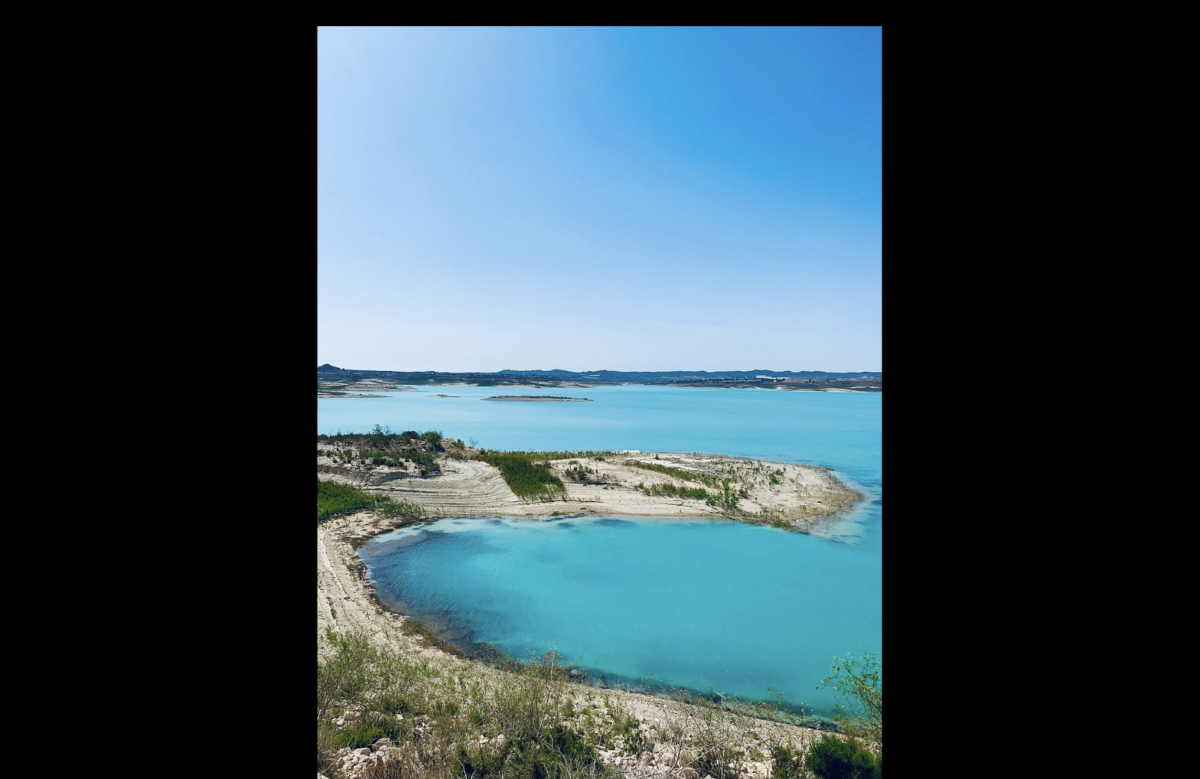
Drive just a short distance inland from the beaches, urbanisations and busy roads of the southern Costa Blanca and the landscape changes remarkably. Among the dry hills and rugged countryside near Torremendo lies an enormous expanse of brilliant blue water: Embalse de La Pedrera, or La Pedrera Reservoir.
For many people living around Torrevieja, Orihuela Costa and Ciudad Quesada, it is surprisingly close — yet it remains one of the less familiar landscapes of the Vega Baja.
A Very Different Side of the Costa Blanca
La Pedrera lies principally within the municipality of Orihuela, close to the village of Torremendo, with its southern reaches extending towards San Miguel de Salinas.
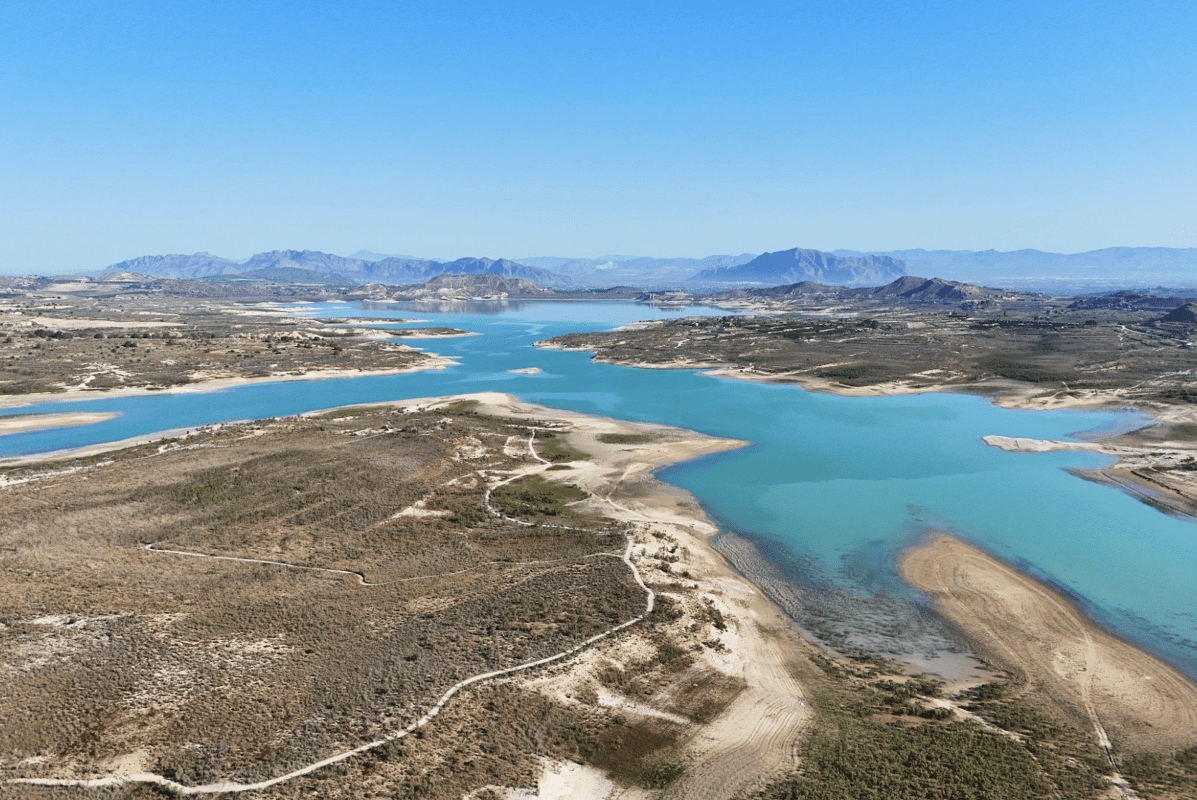
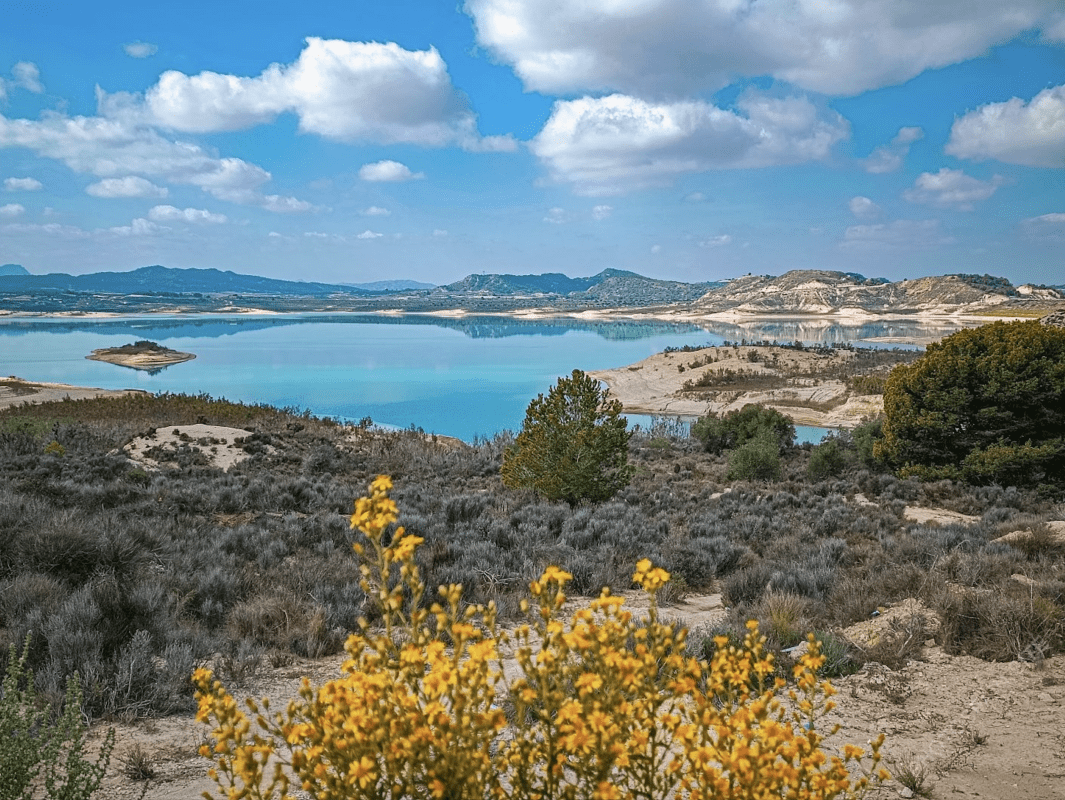
The contrast is what makes the reservoir so striking. The surrounding terrain is characteristically dry and earthy, with low hills, scrubland and exposed pale and grey-blue soils. Against this almost semi-arid landscape, the blue and turquoise water can look quite extraordinary.
Depending upon the light, weather and water level, its appearance changes considerably. On a clear day, viewed from higher ground, there are places where the landscape looks almost otherworldly.
But despite its natural appearance, La Pedrera is entirely artificial.
Why Was La Pedrera Built?
The reservoir exists primarily because of one of Spain’s most important and controversial pieces of water infrastructure: the Tajo–Segura Water Transfer.
Unlike many reservoirs, La Pedrera does not depend primarily upon a large river flowing naturally into it. Its own catchment is relatively small. Instead, it functions principally as a huge regulating reservoir. Storing and distributing water brought into south-eastern Spain through the Tajo–Segura system.
The first geological studies for the project began in 1967. Construction of the dam started in 1973 and proved considerably more complicated than originally anticipated. Requiring several extensions to the construction programme. The completed works were provisionally accepted in 1983.
Today, the reservoir remains an important component of the region’s water infrastructure. Water stored here helps supply irrigated agriculture, particularly in the Campo de Cartagena. While also contributing to urban water supplies through the Mancomunidad de los Canales del Taibilla. citeturn0search1turn0search8
Just How Big Is It?
It is difficult to appreciate the scale of La Pedrera until you see it from above or travel around the surrounding countryside.
The reservoir covers approximately 1,272 hectares and can hold around 247 million cubic metres of water. The main dam stretches 716 metres and rises more than 60 metres above the original watercourse.
That makes this much more than an attractive local lake. It is a substantial piece of hydraulic engineering designed. To help sustain communities and agriculture across a region where water has always been one of the most precious resources.
An Unexpected Haven for Wildlife
Over the decades, this man-made reservoir has also developed an ecological role that was never its principal reason for existing.
Orihuela describes La Pedrera as an artificial wetland. While environmental planning documents recognise its value as a refuge for aquatic birds moving between the different wetlands of the region.
This makes the reservoir part of a much wider and fascinating network of contrasting environments across the southern Costa Blanca. From the salt lakes of Torrevieja and La Mata to the wetlands and salinas found farther south.
It is another reminder that some of the landscapes we now regard as part of nature have. In fact, developed through a complicated interaction between human engineering and the natural world.
A Landscape Worth Discovering
La Pedrera is perhaps best appreciated not as a conventional tourist attraction but as a landscape.
There are no promenades lined with cafés, no beachfront restaurants and none of the commercial development associated with the nearby coast. Instead, its appeal lies in the enormous open skies, distant mountains, changing colours and extraordinary contrast between water and the surrounding dry countryside.
It is particularly impressive when viewed from the higher ground around the reservoir, where its scale becomes much more apparent.
And for photographers, it offers something completely different from the familiar Costa Blanca imagery of beaches, palm trees and Mediterranean coves.
More Than Just a Beautiful View
Perhaps the most interesting thing about Embalse de La Pedrera is that its beauty is almost incidental.
It was not created as a beauty spot. It was built to solve a practical problem: how to store and distribute water in one of the driest parts of Spain.
Yet more than four decades later, engineering and nature have combined to create one of the most distinctive inland landscapes of southern Alicante.
For those of us living along the southern Costa Blanca, it is also a reminder of just how quickly our surroundings can change.
Within a relatively short drive, we can leave behind beaches, resorts and busy coastal communities and find ourselves looking across a vast turquoise reservoir surrounded by seemingly empty countryside.
Embalse de La Pedrera may not be one of the Costa Blanca’s famous attractions — but perhaps that is precisely part of its charm.